
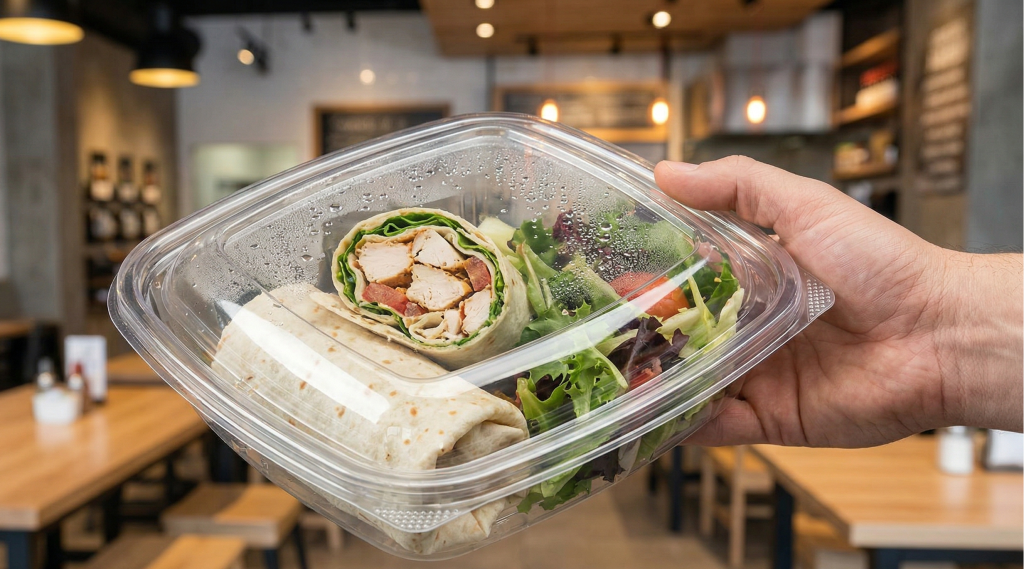
The food your restaurant or catering operation produces is only as good as the packaging that delivers it. A perfectly prepared meal that arrives cold, soggy, or leaking is a refund request, a bad review, and a lost customer. For food service operations across Iowa, Nebraska, and Wisconsin — from quick-service restaurants and coffee shops to full-service caterers, delis, and institutional kitchens — the right disposable packaging isn’t a commodity decision. It’s a direct reflection of your food quality and your brand.
At the same time, food service margins are tight and packaging is a controllable cost. The goal is finding the right balance: packaging that performs, at a price that makes sense, from a supplier who keeps you stocked reliably. This guide covers what Midwest food service operations need to know about selecting and sourcing cups, containers, wraps, and tabletop supplies.
Why Food Service Packaging Matters More Than It Used To
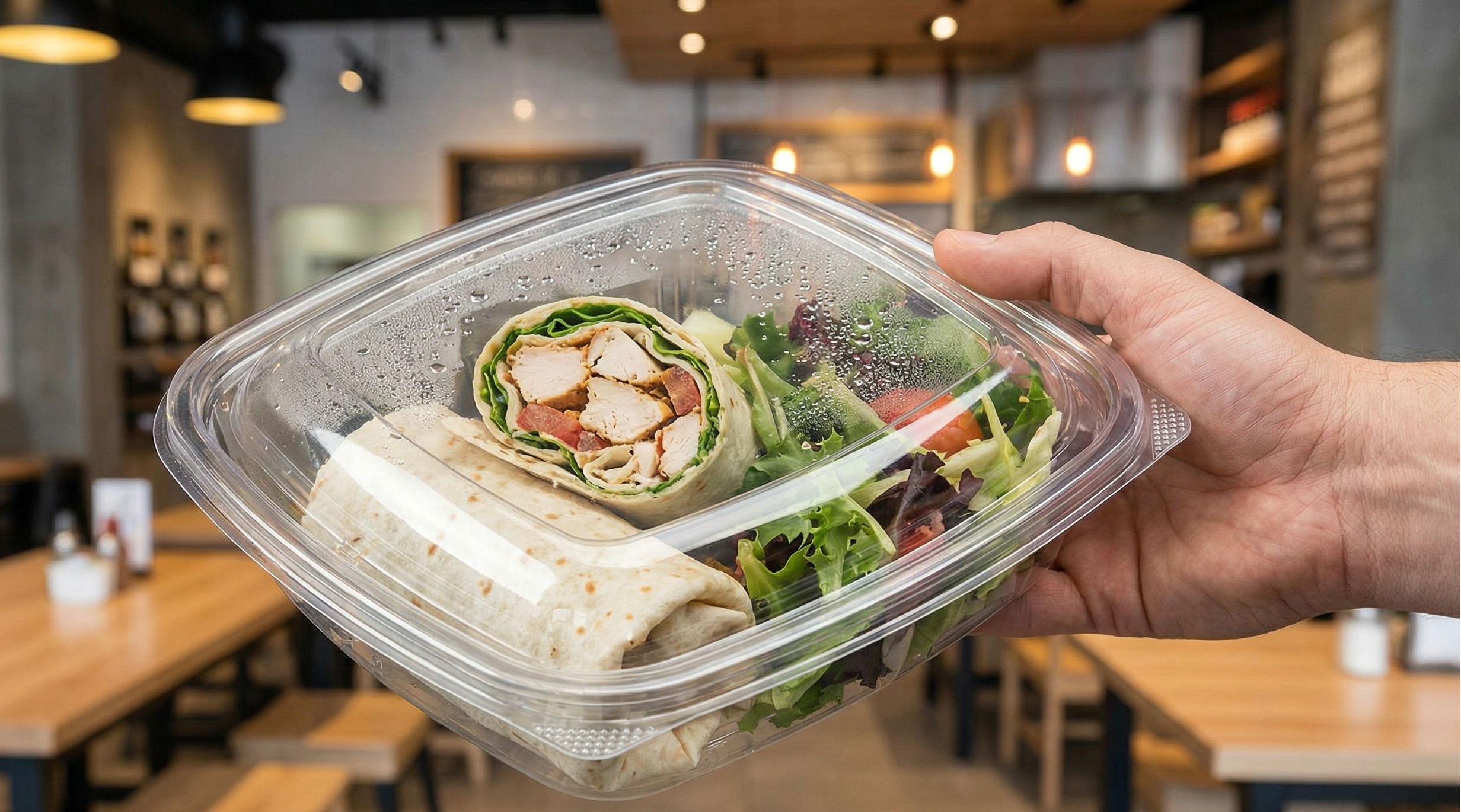
Ten years ago, takeout was a secondary revenue channel for most restaurants. Today it is often the primary one. The growth of third-party delivery platforms, curbside pickup, and catering orders means that a much higher percentage of your food is now leaving your kitchen in packaging — and being judged by customers entirely on the experience that packaging creates.
That shift has raised the stakes for packaging decisions in several important ways:
- Heat retention matters more when food travels 15 minutes in a delivery bag rather than 15 steps from the kitchen to the table.
- Leak resistance is critical when containers are placed in bags, on car seats, or on delivery bikes.
- Presentation has moved from the plate to the container — customers open their takeout order expecting it to look as good as it would in your dining room.
- Sustainability is increasingly a customer expectation, and packaging choices are one of the most visible ways food service operations signal their environmental values.
Getting packaging right is no longer just an operational detail. It is part of the product.
Choosing the Right Food Containers for Your Operation
The container category is where most food service operators spend the most time making decisions — and where the wrong choice is most costly. Here’s how to think through the main options.
Foam Containers
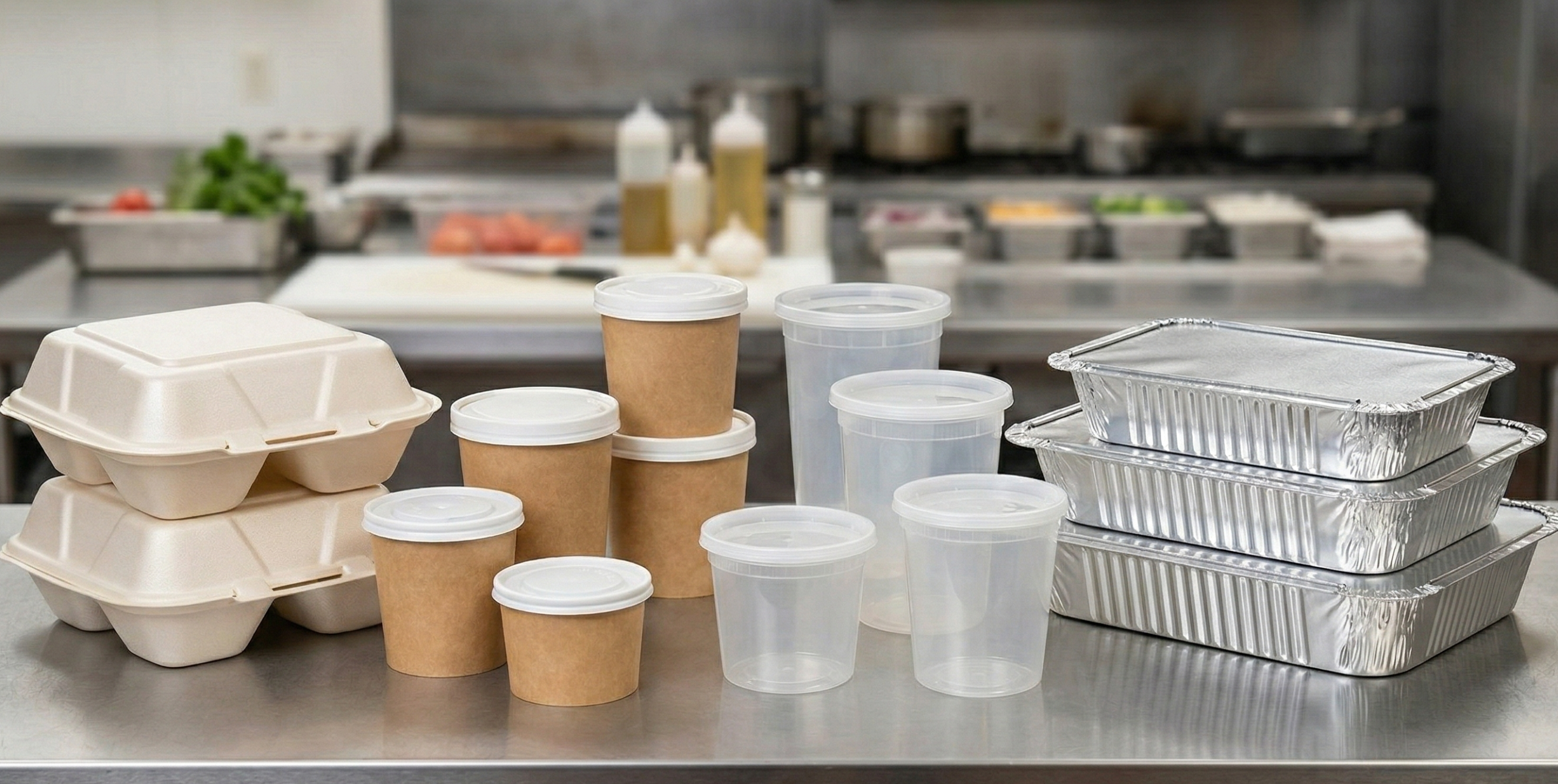
Expanded polystyrene (foam) containers remain one of the most effective materials for heat retention in takeout food. They are lightweight, inexpensive per unit, and genuinely keep hot food hotter for longer than most alternatives. The tradeoff is environmental perception — some customers and municipalities have strong views on foam packaging. Know your customer base and local regulations before committing to foam as your primary container format.
Paper Containers and Paperboard
Paper-based containers and paperboard clamshells have improved significantly in recent years. Many are coated for grease and moisture resistance, and they carry a more positive environmental perception than foam. They work well for sandwiches, burgers, fries, and other items where extreme heat retention is less critical. For hot entrees requiring significant heat retention, paper containers typically underperform foam.
Plastic Containers and Lids
Clear plastic containers are the standard for cold applications — salads, deli items, fruit cups, cold desserts — where visibility of the product is part of the appeal. They are also widely used for catering setups where food is transported cold and reheated. Look for containers with tight-fitting lids that create a secure seal, especially for anything liquid or semi-liquid.
Aluminum Foil Containers and Pans
For catering, institutional food service, and high-volume hot food operations, aluminum foil pans are the workhorses of the industry. They go from oven to transport to serving without any transfer, they retain heat exceptionally well under foil lids, and they are universally understood by customers. Full-size, half-size, and quarter-size pans in multiple depths give caterers flexibility across their entire menu.
Matching Container to Food Type
The most common packaging mistake in food service is using a general-purpose container for everything rather than matching the container format to the food. Soups and sauces need containers with locking lids and no seam leakage. Crispy fried items benefit from vented containers that release steam and prevent sogginess. Salads need containers that don’t crush delicate leaves. Taking 20 minutes to evaluate your menu against your container options will prevent a lot of customer complaints.
Beverage Packaging: Cups, Lids, Sleeves & Carriers
For coffee shops, quick-service restaurants, juice bars, and any operation serving beverages to go, the cup program is a daily high-volume purchasing decision. Getting it right affects both cost and customer experience.
Hot Beverage Cups
Hot cups are typically double-walled or single-wall with a sleeve for insulation. Double-wall cups eliminate the need for a separate sleeve and provide a cleaner, more premium look. Single-wall cups with sleeves cost less per unit and give customers a tactile grip. Both work; the right choice depends on your price point and brand positioning.
Cold Beverage Cups
Clear plastic cold cups — whether for iced coffee, smoothies, fountain drinks, or lemonade — come in a wide range of sizes and in both PET (hard plastic) and PP (softer, more flexible) materials. PET cups have better clarity and a more premium look. PP cups are typically less expensive. Dome lids for layered drinks and flat lids for strawed beverages are both standard offerings.
Cup Lids, Sleeves, Carriers and Holders
Lids, sleeves, and carriers are often afterthoughts but they affect the customer experience significantly. A lid that doesn’t fit your cup securely is a spill waiting to happen. A carrier that can’t handle the weight of four filled cups is a liability. Buy lids from the same source as your cups whenever possible to guarantee fit compatibility, and don’t underestimate the importance of testing carrier strength under full load before committing to a case quantity.
Wraps, Films, Foils & Deli Paper
For delis, sandwich shops, butcher operations, and any food service business that wraps individual items, the right wrapping material is as important as the container. The main categories to know:
- Deli paper and sandwich wraps — waxed, dry wax, and unwaxed options for wrapping sandwiches, burgers, and deli items. Dry wax paper is the most common choice for most deli applications; it’s grease-resistant but not moisture-proof.
- Plastic film and cling wrap — used to wrap food items for display, storage, or transport. Commercial-grade films are significantly more cling-effective and easier to work with than consumer products.
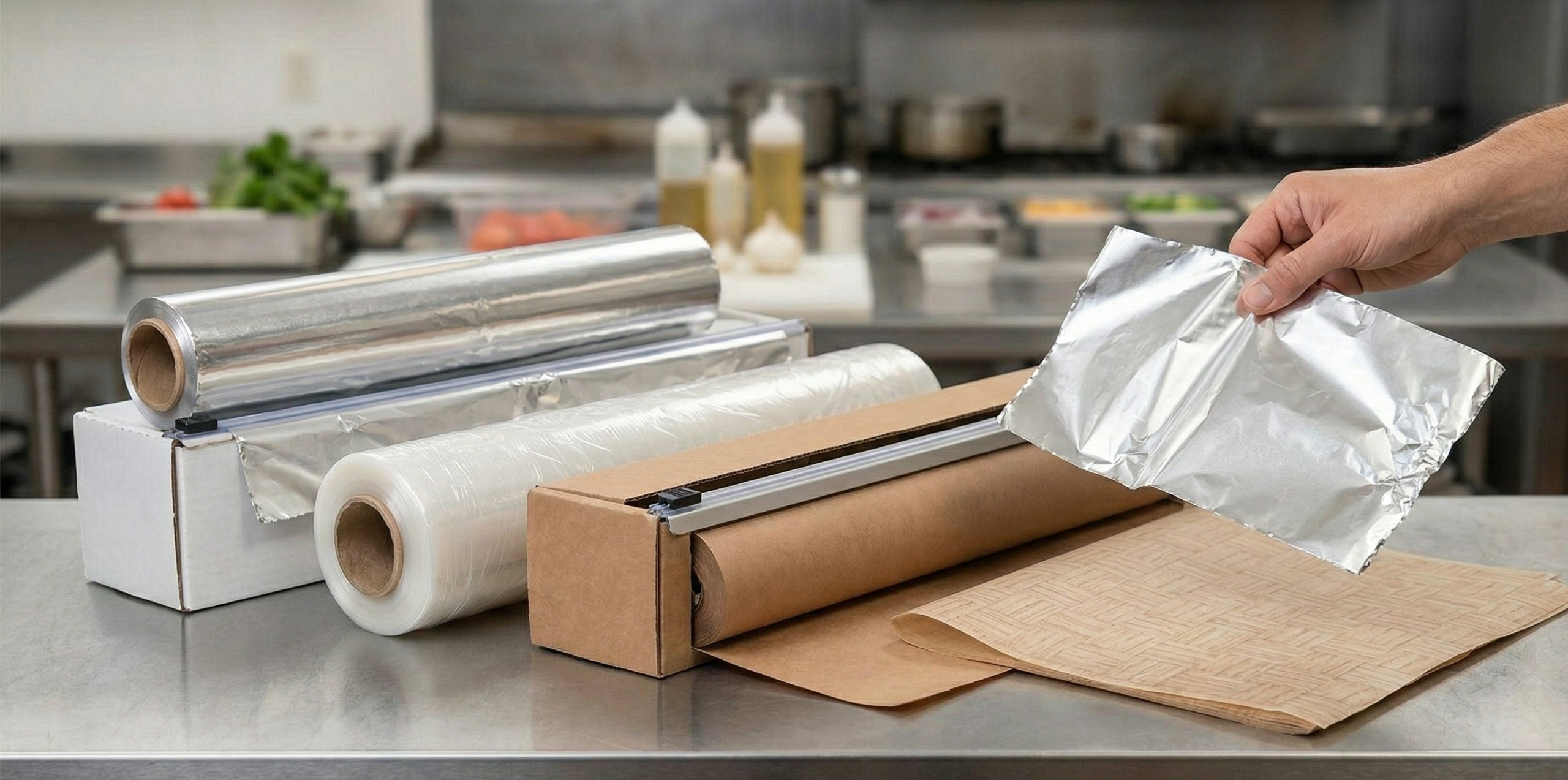
- Aluminum foil — the standard for wrapping hot items for hold or transport, lining sheet pans, and covering catering pans. Commercial foil in standard roll sizes is a staple in virtually every food service operation.
- Freezer and waxed papers — for operations that freeze product or need moisture barriers for wrapping items destined for cold storage.
- Butcher paper and kraft rolls — for meat operations, farmers market vendors, and any operation wrapping product at the counter. Available in standard sizes and on cutter box dispensers for high-volume use.
Tabletop and Serving Supplies: The Details That Add Up
For dine-in, catering, and events, tabletop disposables complete the picture. These items are purchased in high volume and their cost adds up quickly — but they also directly affect the perceived quality of the dining experience you deliver.
- Napkins — 1-ply, 2-ply, dinner size, beverage size, interfold and pop-up dispensing formats. Higher-quality napkins reduce per-table usage because customers use fewer of them per meal.
- Disposable cutlery — heavyweight plastic cutlery significantly outperforms standard-weight for catering and delivery. Cutlery kits (fork, knife, spoon, napkin, salt and pepper in a single wrapped package) are a time-saver for catering setups.
- Plates and bowls — foam, paper, and molded fiber options for different price points and sustainability preferences.
- Straws and stirrers — with increasing restrictions on plastic straws in some markets, paper straws and compostable options are worth stocking alongside standard plastic for customer flexibility.
- Table covers and placemats — for catering and events, disposable table covers provide a clean presentation without laundry logistics.
Buying Smart: Case Quantities, Par Levels, and Supplier Relationships
Food service packaging is a volume purchasing category. The difference between buying by the sleeve at a retail store and buying by the case from a commercial distributor can be 40–60% per unit. For high-volume items like cups, lids, and containers that your operation uses every single day, that difference compounds into significant annual savings.
A few practical principles for managing packaging costs effectively:
- Set par levels for every item — know how much you use per week and maintain a two-to-three week buffer. Running out of cups or containers mid-service is a revenue problem, not just an inconvenience.
- Consolidate your supplier list — buying packaging from the same distributor as your janitorial and safety supplies simplifies ordering, reduces delivery complexity, and often qualifies you for better pricing on total volume.
- Test before committing to case quantities — especially for new container formats. Ask your supplier for samples of any new product before placing a full case order.
- Consider menu-packaging alignment annually — as your menu evolves, your packaging needs change. An annual review with your supplier ensures you’re not carrying obsolete SKUs or missing better options.
Capital Sanitary Supply serves food service operations across Iowa, Nebraska, and Wisconsin with a full line of packaging supplies — containers, cups, lids, wraps, foils, and tabletop disposables — in case quantities with regional distribution that keeps your kitchen stocked reliably. Our team works with restaurants, caterers, institutional kitchens, delis, and food manufacturers to simplify their packaging supply chain and reduce per-unit costs.
The Bottom Line: Packaging Is Part of the Product
For food service operations across the Midwest, the right packaging is not just a cost of doing business — it’s a direct extension of the food quality and customer experience you work hard to deliver. Choosing containers that hold temperature, cups that don’t leak, and wraps that protect your product from kitchen to customer is worth the time it takes to get right.
And when you’re buying in case quantities from a reliable regional distributor, the per-unit cost difference between good packaging and great packaging is often smaller than you’d expect — while the difference in customer experience is significant.
Need food service packaging supplies for your Iowa, Nebraska, or Wisconsin operation?
Capital Sanitary Supply stocks cups, containers, lids, wraps, foils, cutlery, and tabletop disposables for food service operations of every size — in case quantities at competitive pricing with reliable regional delivery. Call us at (515) 244-4291 or visit capitalsanitary.com to get started.
Frequently Asked Questions: Food Service Packaging Supplies
What food service packaging do restaurants need for takeout and delivery?
At minimum, a restaurant offering takeout or delivery needs food containers with secure lids matched to their menu items, beverage cups and lids, bags for order assembly, and napkins and cutlery. The specific container types depend on the menu — soups need leak-resistant containers with locking lids, hot entrees benefit from foam or vented containers for heat retention, and cold items like salads work best in clear plastic containers. Most operations also need foil pans or paper bags for bulk and catering orders.
What is the difference between foam and paper food containers?
Foam containers offer superior heat retention and are very cost-effective per unit, making them well-suited for hot takeout food that needs to stay warm during delivery. Paper and paperboard containers have a more positive environmental perception and are preferred by many customers and municipalities, but generally retain heat less effectively than foam. The right choice depends on your menu, your customer base, your local regulations, and your sustainability goals — many operations stock both and use each where it performs best.
How do I choose the right takeout containers for my menu?
Start by grouping your menu items by their packaging requirements: hot vs. cold, liquid vs. solid, crispy vs. saucy. Hot soups and sauces need containers with tight, leak-resistant lids. Crispy fried items benefit from vented containers that release steam. Cold salads and deli items work well in clear plastic containers that showcase the product. Catering and bulk orders typically call for aluminum foil pans. Matching container to food type prevents the two most common customer complaints — food arriving cold and food arriving with packaging failures.
How do I reduce food service packaging costs for my restaurant?
The most impactful step is buying in case quantities from a commercial distributor rather than retail quantities from a restaurant supply or grocery store — the per-unit savings are typically 40–60%. Consolidating your packaging purchases with a single supplier also simplifies ordering and can qualify you for volume pricing. Setting par levels for each item prevents emergency last-minute purchases at higher prices. Finally, testing new container formats before committing to case quantities prevents costly mistakes when switching products.
Where can I buy food service packaging supplies wholesale in Iowa, Nebraska, or Wisconsin?
Capital Sanitary Supply serves food service operations across Iowa, Nebraska, and Wisconsin with a full range of commercial packaging supplies — containers, cups, lids, deli wraps, foil pans, cutlery, napkins, and tabletop disposables — in case quantities with regional distribution. We serve restaurants, caterers, delis, institutional kitchens, and food manufacturers throughout the Midwest. Visit capitalsanitary.com or call (515) 244-4291 to set up an account.
What disposable supplies does a catering company need?
A full-service catering operation typically needs aluminum foil pans in multiple sizes for hot food transport, plastic containers for cold items, serving utensils, heavyweight cutlery kits, dinner and beverage napkins, table covers, plastic wrap and foil for covering pans during transport, and bags or totes for order assembly. Many caterers also stock hot and cold beverage cups for on-site service. Buying all of these from a single commercial distributor simplifies ordering and reduces delivery complexity significantly.