
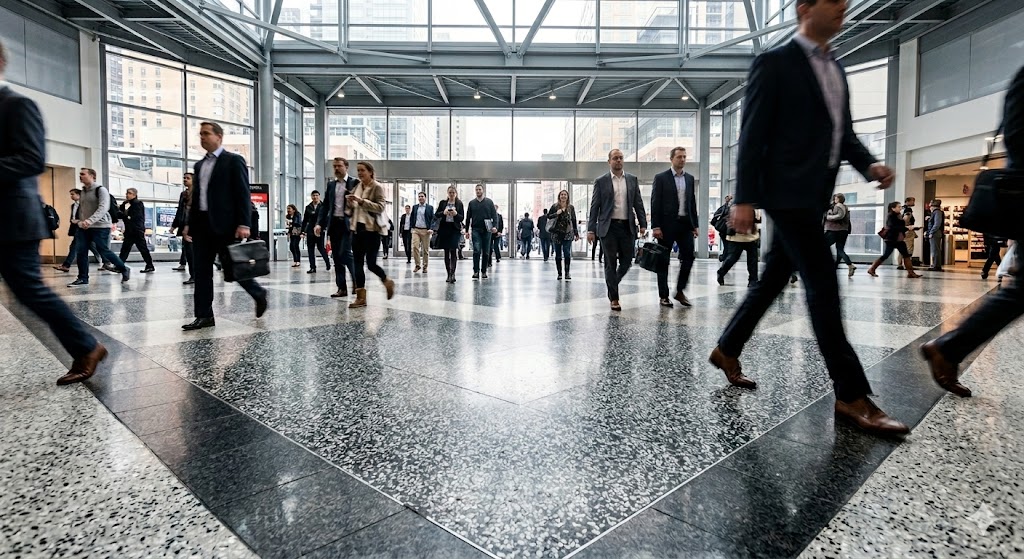
Your floors take the hardest hit of any surface in your building. Every cart, chair, boot, and pallet that crosses your threshold leaves a mark — and in Iowa, Nebraska, and Wisconsin, that damage accelerates every winter when salt, slush, and moisture get tracked in from parking lots. Left unmanaged, deteriorating floors don’t just look bad. They become slip hazards, they drive up refinishing costs, and they tell every customer and inspector who walks through your door that maintenance isn’t a priority.
The good news is that with the right commercial floor care supplies and a consistent maintenance schedule, most businesses can protect their floors for years longer than those on reactive programs. This guide breaks down what a complete floor care program looks like, which surfaces need what treatment, and how to choose the right products and equipment for your facility.
Why Floor Care Is One of the Highest-ROI Investments in Your Facility
It might not feel like a strategic decision, but your floor care program directly impacts your bottom line in at least three ways.
1. Floor Replacement Is Expensive. Maintenance Is Not.
Replacing vinyl composite tile, hardwood, or polished concrete costs anywhere from $3 to $15 per square foot before labor. A consistent stripping, sealing, and finishing program for hard floors extends their lifespan by years — sometimes decades. The supplies cost a fraction of what a single floor replacement project would run.
2. Slips and Falls Are a Liability.
The National Safety Council reports that slips, trips, and falls are among the leading causes of workplace injuries. Worn floor finish, wet floors without proper signage, and dirty entrance mats are common culprits. A proactive floor care program reduces both the physical and legal risk of these incidents.
3. First Impressions Are Made at Floor Level.
Customers and clients notice dirty, scuffed, or dull floors immediately — even if they can’t articulate why a space feels run-down. Healthcare facilities, retailers, schools, and office buildings all have a stake in presenting clean, well-maintained floors as part of the experience they deliver.
The Midwest Floor Care Challenge: Why Iowa, Nebraska & Wisconsin Facilities Need a Year-Round Strategy
Running a floor care program in the Midwest comes with specific challenges that facilities in warmer climates don’t face to the same degree.
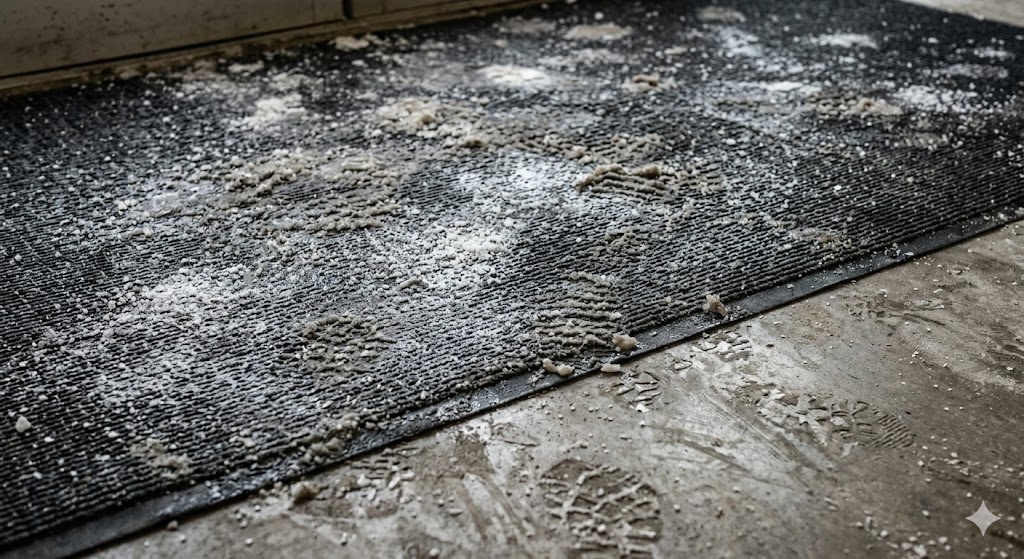
From November through March, every entrance in Iowa, Nebraska, and Wisconsin becomes a collection point for road salt, ice melt residue, sand, and wet slush. That material doesn’t just dirty your floors — it chemically attacks floor finish and sealer, accelerating breakdown at a rate that’s difficult to keep up with if you don’t have the right products.
A well-designed Midwest floor care program accounts for this by:
- Using high-durability floor finishes with strong resistance to salt and chemical wear
- Placing high-performance scraper and wiper entrance mats at every entry point to capture debris before it reaches interior floors
- Increasing floor scrubbing frequency during winter months
- Using a neutralizing cleaner to remove salt residue before it dries and etches the finish
Summer brings its own considerations: increased foot traffic, outdoor events, construction dust, and humidity that affects drying times for floor finish applications. Building a seasonal cadence into your maintenance schedule is the difference between a floor program that works and one that always feels like it’s catching up.
Understanding Your Floor Type: What Each Surface Needs
Not all floors require the same products or the same program. Applying the wrong chemical to the wrong surface is a common and costly mistake. Here’s a quick overview of the most common commercial floor types and what they require.
Vinyl Composite Tile (VCT)
VCT is among the most common commercial flooring types in schools, retail stores, and healthcare facilities across the Midwest. It requires a regular cycle of stripping (removing old finish), sealing (applying a base sealer), finishing (applying multiple coats of floor finish), and daily maintenance mopping with a neutral cleaner. High-speed burnishing between finish applications maintains the shine and extends the life of each coat.
Polished Concrete
Polished concrete is increasingly popular in industrial facilities, retail spaces, and modern offices. It requires different chemistry than VCT — typically a concrete guard or densifier rather than a film-forming finish — and autoscrubbers with appropriate pads. The good news is that a well-maintained polished concrete floor is extremely durable and lower maintenance long-term.
Ceramic and Quarry Tile
Common in restaurant kitchens, restrooms, and entryways, tile and grout require different tools and chemistry. Grout is porous and holds bacteria and soil; it benefits from alkaline cleaners and stiff-bristle brushes or brush-head autoscrubbers. Sealing grout regularly significantly reduces how much effort is required to keep it clean.
Hardwood and Sport Floors
Hardwood floors in gyms, school cafeterias, and office spaces require wood-specific floor care chemistry. Using a standard vinyl floor finish on hardwood will damage it. This is one area where product selection genuinely matters — the right wood floor cleaner and finish protects the surface; the wrong one voids the warranty and destroys the finish.
Building Your Commercial Floor Care Supply Program: The Essential Components
A complete floor care program requires both chemistry and equipment working together. Here’s what belongs in a well-stocked program.
Floor Care Chemicals
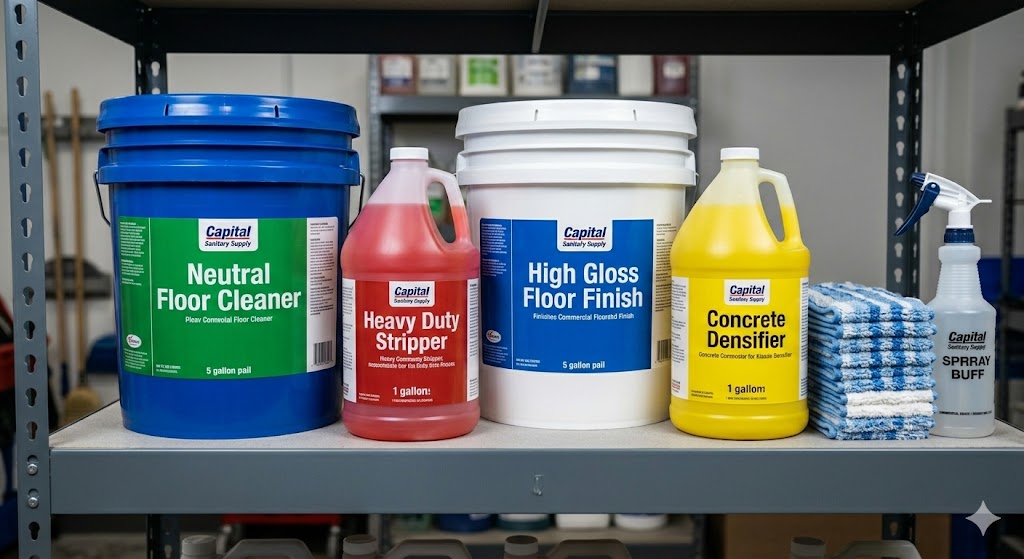
Every program needs these core chemical categories:
- Neutral floor cleaner — for daily mopping without stripping finish
- Floor stripper — removes old layers of finish and sealer before re-coating
- Floor sealer — base coat that protects the subfloor and anchors finish coats
- Floor finish — the top coats that create shine and protect against wear
- High-speed or spray-buff product — used between finish applications to maintain gloss
- Specialty cleaners — for grout, concrete, wood, or other specific surfaces
Mopping Equipment
Traditional wet mop systems — mop heads, handles, buckets, and wringers — remain the standard for daily maintenance mopping in most facilities. Flat mop systems with microfiber pads are increasingly popular for lighter duty daily cleaning and touch-ups, particularly because they require less chemical and are easier for staff to use consistently.
Floor Machines and Autoscrubbers
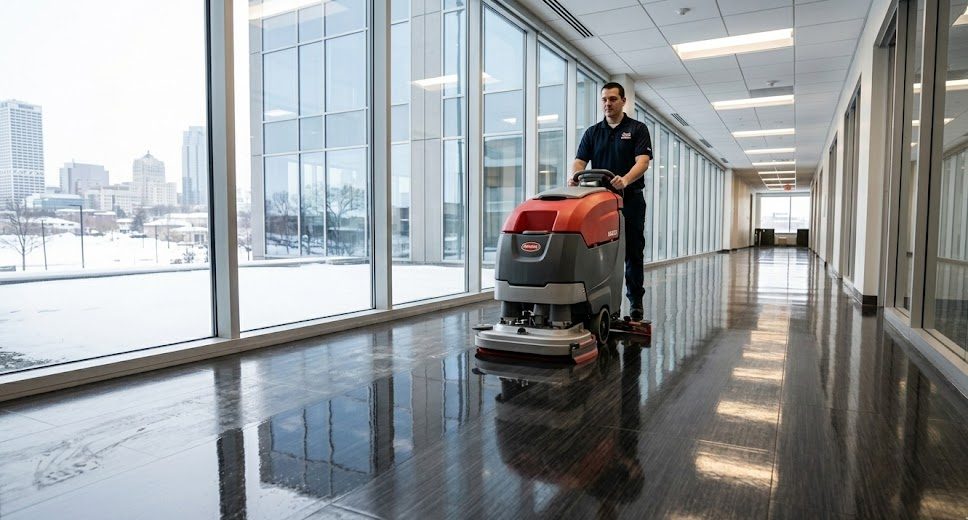
For facilities with more than a few thousand square feet of hard floor, manual mopping is inefficient and inconsistent. Commercial floor machines — single-disc rotary scrubbers, walk-behind autoscrubbers, and ride-on machines for larger facilities — dramatically improve cleaning results and reduce labor time. Autoscrubbers scrub and vacuum in a single pass, leaving floors dry and reducing slip hazards during cleaning.
Choosing the right machine depends on your floor area, layout, and surface type. A capital outlay on equipment typically pays for itself within one to two years through reduced labor and chemical costs.
Entrance Matting
Entrance mats are the first line of defense for interior floors. Studies suggest that 80% of soil entering a building is tracked in on the bottom of shoes. Placing the right combination of scraper mats (outside), wiper mats (inside entry), and combo mats (high-traffic zones) captures that soil before it reaches your maintained floor surfaces — reducing mopping frequency and protecting your floor finish.
How to Choose a Floor Care Supplier in Iowa, Nebraska & Wisconsin
Not all janitorial distributors are equally equipped to support a commercial floor care program. When evaluating a supplier, look for:
- Product depth across chemical, equipment, and matting categories — so you’re not piecing together a program from multiple vendors
- Technical expertise — staff who can recommend the right products for your specific floor type, traffic levels, and budget
- Equipment support — access to floor machines and autoscrubbers, plus service and parts availability when equipment needs maintenance
- Regional distribution — reliable delivery to your Iowa, Nebraska, or Wisconsin location without long lead times
- Training support — help getting your custodial team trained on proper dilution, application, and equipment use
Capital Sanitary Supply has served businesses across Iowa, Nebraska, and Wisconsin for decades, with multiple distribution locations to ensure reliable product availability. Our team works with facility managers, building service contractors, schools, healthcare facilities, and food service operations to build floor care programs that fit their surfaces, their staff, and their budget.
The Bottom Line: A Floor Care Program Pays for Itself
Commercial floors are an asset worth protecting. Whether you manage a school, a grocery store, a medical clinic, or a warehouse in Iowa, Nebraska, or Wisconsin, the right combination of floor care chemicals, equipment, and entrance matting will extend the life of your floors, reduce liability, and keep your facility looking its best year-round.
The Midwest winter alone is reason enough to make sure your program is dialed in before the first freeze. Start with an honest assessment of your current floor types, traffic volumes, and maintenance frequency — then build a supply program around those realities.
Ready to build a floor care program for your facility?
Contact Capital Sanitary Supply to speak with a janitorial supply specialist. We serve businesses across Iowa, Nebraska, and Wisconsin with commercial floor care chemicals, equipment, entrance matting, and the expert guidance to put it all together. Call us at (515) 244-4291 or visit capitalsanitary.com.
Frequently Asked Questions: Commercial Floor Care Supplies
What commercial floor care supplies do I need for my business?
At minimum, a commercial floor care program requires a neutral daily floor cleaner, a floor stripper, a sealer, and a floor finish. Most facilities also need mopping equipment (mop heads, buckets, wringers or a flat-mop system), scrubbing pads, and entrance mats to keep soil off interior floors. Larger facilities benefit from a walk-behind autoscrubber, which cleans more consistently and saves significant labor time compared to manual mopping.
How often should I strip and wax commercial floors?
Most commercial facilities should strip and re-coat their floors one to two times per year, depending on traffic volume and how well the daily maintenance program is maintained. High-traffic areas like school hallways or retail entrances may need stripping more frequently, while low-traffic offices can often go longer between full strip-and-recoat cycles. Regular burnishing and spray-buffing between coats significantly extends the time between full strip jobs.
What’s the difference between floor stripper, sealer, and finish?
Floor stripper is a strong alkaline chemical used to remove old layers of finish and sealer down to the bare floor surface. Floor sealer is applied first after stripping — it penetrates and protects the subfloor material and provides a foundation for finish coats to bond to. Floor finish is the topcoat applied in multiple layers that creates the shine, protects against wear and scuffs, and is what gets burnished or buffed to maintain gloss over time.
What floor care products work best in Midwest winters?
In Iowa, Nebraska, and Wisconsin, the biggest winter floor care challenges are road salt and ice melt residue tracked in from outside. Look for high-durability floor finishes formulated with strong resistance to chemical attack, and use a pH-neutral or mildly acidic neutralizing cleaner specifically designed to lift salt residue before it dries and etches the finish. High-quality scraper mats at every entrance are equally important — they stop the majority of salt and moisture before it reaches your interior floors.
Do I need an Floor Scrubber or autoscrubber or can I just mop?
For facilities under roughly 2,000 square feet, a well-maintained mop system is often sufficient. But for larger spaces — schools, warehouses, retail stores, healthcare facilities — a walk-behind autoscrubber will clean more thoroughly, more consistently, and in far less time than manual mopping. Autoscrubbers also leave floors drier immediately after cleaning, which reduces slip hazards during the cleaning process. The labor savings typically offset the equipment cost within one to two years.
Where can I buy commercial floor care supplies in Iowa, Nebraska, or Wisconsin?
Capital Sanitary Supply serves businesses across Iowa, Nebraska, and Wisconsin with a full range of commercial floor care chemicals, floor machines, autoscrubbers, mopping equipment, and entrance matting. With multiple distribution locations across the region, we provide reliable delivery and local expertise to help you build the right floor care program for your facility. Visit capitalsanitary.com or call (515) 244-4291 to get started.