OSHA’s Hazard Communication Standard, commonly called HazCom, is one of the most cited regulations in commercial facility inspections. It governs how hazardous chemicals are labeled, stored, and communicated to workers, and it applies directly to GHS chemical labels and OSHA-compliant cleaning requirements in every commercial building in Iowa, Nebraska, and Wisconsin.
Despite being in effect since 2012, when OSHA aligned its HazCom standard with the Globally Harmonized System (GHS) of Chemical Classification and Labeling, GHS compliance remains one of the most common gaps in facility safety programs. The reason is not ignorance of the regulation: most safety managers know HazCom exists. The gap is in execution, specifically in ensuring that the cleaning staff who actually handle chemicals every day understand what the labels and Safety Data Sheets mean, and that secondary containers are consistently labeled in every cleaning room and supply closet.
This guide covers what your facility needs to have in place and what your cleaning staff needs to understand to meet GHS and HazCom requirements. All cleaning chemicals in our catalog ship with GHS-compliant labels and complete Safety Data Sheets.
What the GHS System Actually Requires
GHS is an international framework for communicating chemical hazards through standardized labels and Safety Data Sheets. OSHA adopted GHS as the basis for its Hazard Communication Standard, which means that all chemical manufacturers selling products in the United States must provide GHS-compliant labels and Safety Data Sheets for their products.
For facility managers and cleaning staff, GHS compliance at the facility level involves three core obligations:
1. Ensuring GHS-labeled containers are in use. All chemicals in your facility should be stored in their original manufacturer’s container with the GHS label intact. A label that has been torn off, painted over, or is no longer legible is a violation and a safety hazard.
2. Labeling all secondary containers. When cleaning staff transfer a chemical from its original container into a spray bottle, mop bucket, or any other container, that secondary container must be labeled with the chemical identity and applicable hazard warnings. This is the most commonly violated aspect of HazCom in commercial facilities.
3. Maintaining accessible Safety Data Sheets. An SDS must be readily accessible for every hazardous chemical used in your facility, and employees must be trained on how to read and use them.
Reading a GHS Label: The Six Required Elements
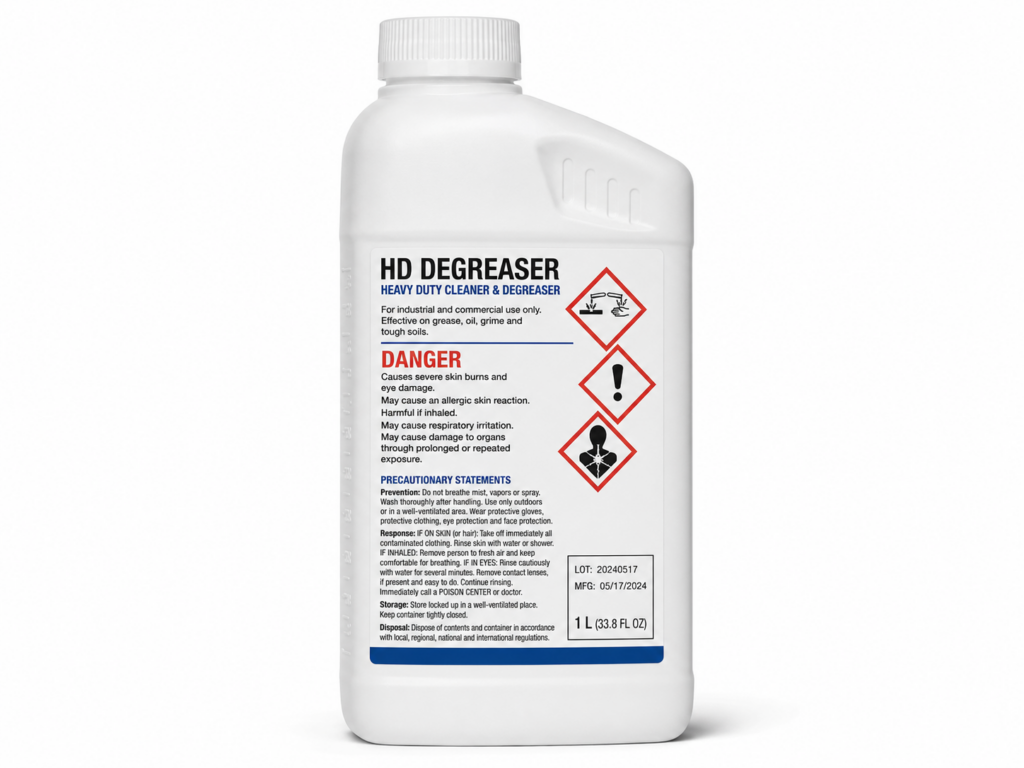
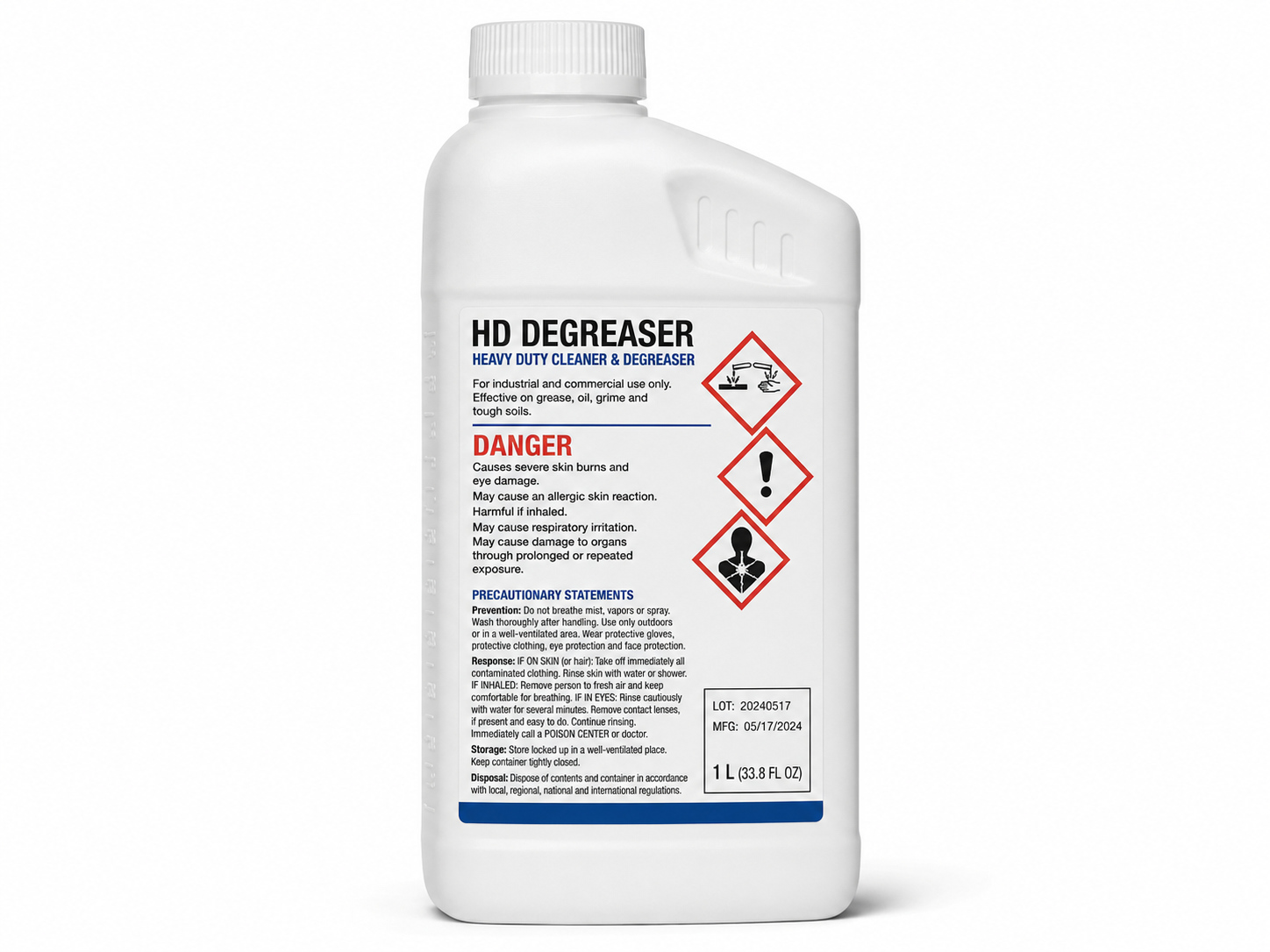
A GHS chemical label contains six standardized elements that communicate hazard information consistently across all chemicals. Understanding what each element means is a practical requirement for anyone handling commercial cleaning products.
Product Identifier
The product name as it appears on the Safety Data Sheet. This connects the label to the corresponding SDS and must be identical between the label and the SDS for the documents to be considered compliant.
Signal Word
Either “Danger” or “Warning.” Danger indicates a more severe hazard category. Warning indicates a less severe category. Some products have no signal word if they do not meet the threshold for a labeled hazard category.
Hazard Statements
Standardized phrases that describe the nature of the hazard in plain language. Examples include “Causes skin irritation,” “Fatal if inhaled,” and “Harmful to aquatic life.” Each hazard statement corresponds to a specific GHS hazard category and has a standardized wording that cannot be modified.
Precautionary Statements
Standardized phrases that describe what to do to minimize or prevent adverse effects from the hazard. These are divided into four types: prevention (“Wear protective gloves”), response (“IF IN EYES: Rinse cautiously with water”), storage (“Store locked up”), and disposal (“Dispose of contents in accordance with local regulations”).
Pictograms
GHS uses nine standardized pictograms: black symbols on a white background inside a red diamond border. Each pictogram represents a specific class of hazard. Familiarity with the nine GHS pictograms is one of the most practical investments in safety training for cleaning staff.
The pictograms and their meanings:
- Flame: Flammable liquids, solids, or gases
- Flame over circle: Oxidizers
- Exploding bomb: Explosive or reactive substances
- Skull and crossbones: Acute toxicity (fatal or toxic doses)
- Corrosion: Skin or eye corrosion, or corrosive to metals
- Health hazard (person with starburst): Carcinogens, respiratory sensitizers, reproductive toxins, or target organ toxins
- Exclamation mark: Irritants, skin sensitizers, acute toxicity at lower hazard levels, or narcotic effects
- Environmental hazard: Acute or chronic aquatic toxicity
- Gas cylinder: Gases under pressure
Most commercial cleaning chemicals carry the exclamation mark (irritant), corrosion (acids and caustics), or health hazard pictograms. Products bearing the skull-and-crossbones or exploding-bomb pictograms are typically not found in general commercial cleaning applications, but should be handled with heightened caution if present.
Supplier Information
The name, address, and phone number of the chemical manufacturer or responsible party. This is the contact for emergency information and SDS requests.
Understanding Safety Data Sheets
A Safety Data Sheet (SDS) is a 16-section standardized document that provides comprehensive hazard and handling information for a chemical product. OSHA requires that an SDS be available for every hazardous chemical in your facility, accessible to employees during their work shift.
The 16 sections of a GHS Safety Data Sheet follow a mandatory sequence. The sections most relevant to cleaning staff are:
Section 1: Identification. Product name, manufacturer, intended uses, and emergency contact information. Confirms the connection between the label product identifier and the SDS.
Section 2: Hazard Identification. The GHS classification, signal word, hazard statements, precautionary statements, and pictograms for the product are consolidated.
Section 4: First Aid Measures. What to do if someone is exposed by inhalation, skin contact, eye contact, or ingestion. This section should be reviewed before working with any new chemical product.
Section 7: Handling and Storage. Specific guidance on how to use the product safely and how to store it, including incompatibility information (chemicals that should not be stored near each other).
Section 8: Exposure Controls and Personal Protective Equipment. What PPE is required when working with the product, including specific types of gloves, eye protection, and respiratory protection? Our PPE and glove catalog covers the protective equipment required for the chemicals your cleaning staff uses.
Section 9: Physical and Chemical Properties. Appearance, odor, pH, flash point, and other physical characteristics. The pH information in this section is particularly relevant to cleaning staff because it governs surface compatibility and the safety of chemical mixing.
Section 14: Transport Information. Relevant for facilities that ship or transport chemicals.
Where to Store SDSs
SDSs must be readily accessible to employees during their work shift. In practice, this means maintaining a physical SDS binder in each cleaning room or supply area, or using an electronic SDS management system with a device accessible to cleaning staff without requiring a computer login.
Electronic SDS management systems that allow employees to look up any chemical product by scanning its barcode are increasingly common in commercial facilities and significantly simplify the compliance burden of maintaining current SDSs for every product in use.
Secondary Container Labeling: The Most Common Compliance Gap
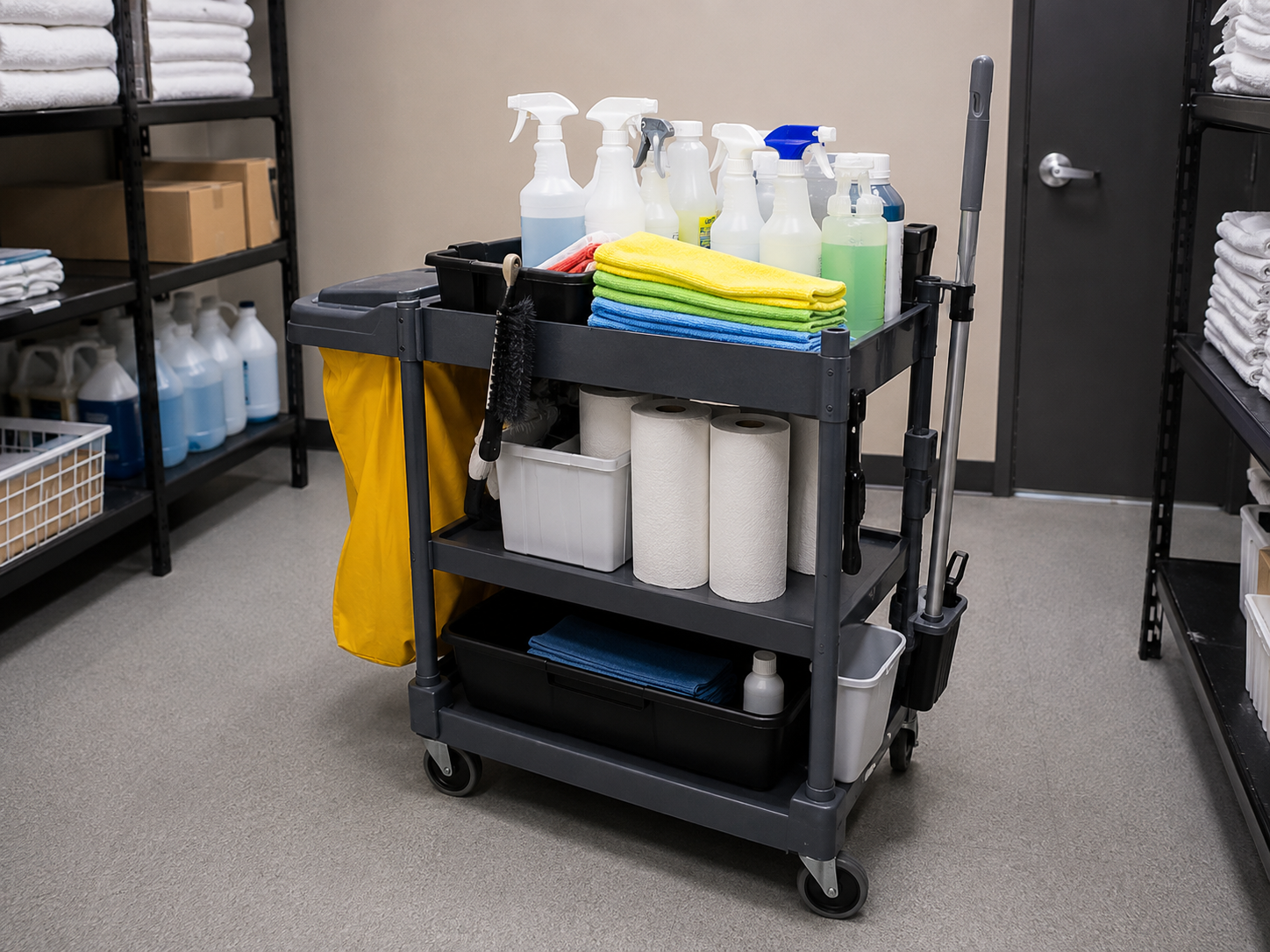
When a concentrated cleaning chemical is diluted and placed into a spray bottle or other transfer container, that secondary container must be labeled. This is not optional, and it is not waived because the contents will be used immediately. The spray bottle in the cleaning cart, which is refilled daily from a bulk concentrate, is a secondary container that requires labeling under HazCom.
A compliant secondary container label requires, at a minimum:
- The product name matches the original container label
- The applicable hazard warnings (can reference pictograms and signal words)
Secondary container labels do not need to be as comprehensive as the original manufacturer label, but they must provide the chemical identity and hazard communication needed for any employee encountering that container to understand what it contains and what hazards it presents.
Pre-printed secondary container label packs for common cleaning products are available through Capital Sanitary Supply and provide the simplest path to consistent secondary container compliance across a cleaning operation. This is especially critical for healthcare facilities and food service operations where inspectors specifically look for HazCom compliance.
The Risk of Unlabeled Containers
An unlabeled container in a cleaning room is a health and safety hazard independent of its regulatory status. The primary real-world risk is that a cleaning employee fills an unlabeled spray bottle with a product, and a second employee, unaware of what the bottle contains, uses it on an incompatible surface, mixes it with an incompatible chemical, or is exposed to it without appropriate PPE.
Chemical mixing injuries from combining bleach-based products with ammonia-based products (a combination that releases toxic chloramine gas) occur in commercial cleaning operations every year, and unlabeled containers contribute to many of these incidents.
Chemical Storage and Compatibility
GHS labeling provides the information cleaning staff need to store chemicals safely. The most important rule for chemical storage in commercial facilities is keeping incompatible chemicals separated and clearly identified.
Common incompatibility combinations relevant to commercial cleaning:
- Chlorine bleach and ammonia-based cleaners: Produce chloramine gas, which causes respiratory irritation and can be fatal in enclosed spaces at high concentrations
- Chlorine bleach and acidic cleaners (bowl cleaners, rust removers): Produce chlorine gas
- Concentrates and oxidizers: Variable reactions depending on specific products; always check Section 7 (Handling and Storage) and Section 10 (Reactivity) of each product’s SDS before co-storing
Cleaning chemical storage areas should be organized so that incompatible products are never adjacent and are clearly labeled by product category. Chemical rooms should be adequately ventilated, and PPE appropriate to the chemicals stored there should be accessible at the entry point. Our complete janitorial supplies program includes the products, labels, and safety documentation that support full HazCom compliance.
Training Requirements Under HazCom
OSHA requires that employees receive training on the hazardous chemicals in their work area before their initial assignment and whenever new hazards are introduced. The training must cover:
- How to detect the presence or release of a hazardous chemical in their work area
- The physical, health, and other hazards of chemicals in the work area
- Measures employees can take to protect themselves, including work practices, emergency procedures, and PPE
- How to read and use the GHS chemical labels, OSHA compliance, cleaning requirements, label elements, and Safety Data Sheets
Training records should be maintained documenting who received training, what it covered, and when it was completed. For facilities with turnover among cleaning staff, integrating GHS and HazCom training into the new-employee onboarding process is the most reliable way to maintain consistent compliance.
Frequently Asked Questions: GHS Labels and OSHA Compliance
What is a GHS label, and what must it include?
A GHS-compliant label includes six required elements: the product identifier (name), signal word (Danger or Warning), hazard statements, precautionary statements, pictograms, and supplier contact information. These elements together communicate the nature of the chemical hazard and what workers should do to protect themselves. Meeting GHS chemical labeling and OSHA compliance cleaning requirements starts with verifying that all six elements are present and legible on every chemical container in your facility.
Do secondary containers for cleaning chemicals need to be labeled?
Yes. Any container that a cleaning chemical is transferred into, including spray bottles, mop buckets used for a single chemical product, and dispensing containers, must be labeled with at a minimum the product name and applicable hazard warnings. This is one of the most frequently cited HazCom violations in commercial facility inspections.
What is a Safety Data Sheet, and where do I need to keep them?
A Safety Data Sheet (SDS) is a 16-section standardized document that provides comprehensive hazard, handling, and emergency response information for a chemical product. OSHA requires that an SDS be accessible to employees for every hazardous chemical in their work area during their work shift. SDSs must be maintained in a physical binder in each work area or through an electronic system accessible to all employees without requiring supervisor assistance.
What are the most important GHS pictograms for cleaning staff to know?
The most commonly encountered pictograms in commercial cleaning applications are the exclamation mark (irritant), the corrosion symbol (acids and caustics, including drain cleaners and disinfectants), and the health hazard symbol (products with sensitization or organ toxicity concerns). Staff should be familiar with all nine GHS pictograms, but these three cover most products used in routine commercial cleaning.
What happens if my facility is not in compliance with OSHA HazCom?
OSHA can cite facilities for HazCom violations during inspections. Common citations include missing or illegible GHS labels on chemical containers, unlabeled secondary containers, missing Safety Data Sheets for products in use, and a lack of documented employee training. Penalties for serious violations range from several hundred to several thousand dollars per citation, and willful or repeat violations can carry significantly higher penalties.
Make sure your facility is HazCom compliant.
Capital Sanitary Supply carries GHS-compliant chemical label supplies, secondary container labels, Safety Data Sheets, and the cleaning chemical products your facility needs to stay HazCom compliant across Iowa, Nebraska, and Wisconsin. Our specialists can also help you review your current chemical inventory and ensure every product in your cleaning program has a current, accessible SDS. Call us at (515) 244-4291 or visit capitalsanitary.com to speak with a specialist.