
Cleaning chemicals are among the largest and most controllable line items in any facility’s operating budget. Yet most facilities spend far more than necessary on them because of a single overlooked problem: manual dilution errors by cleaning staff. For facility managers evaluating dilution control systems and commercial cleaning programs, the financial case is straightforward once you understand what uncontrolled dilution is actually costing.
When a custodian pours a glug of concentrated floor cleaner into a mop bucket by eye, they almost never hit the correct dilution ratio. Studies across commercial and institutional cleaning operations consistently show that manual measurement results in chemical over-dilution between 50 and 300 percent compared to the labeled rate. That means facilities are routinely using two to four times more chemicals than they need to clean effectively, and paying for it all.
Dilution control systems solve this problem completely. For facility managers across Iowa, Nebraska, and Wisconsin looking to reduce chemical costs without sacrificing cleaning performance, understanding how these systems work and which options are available is one of the highest-return conversations in facility management. Explore our full selection of dilution control dispensers to see the systems available for your operation.
What Is a Dilution Control System?
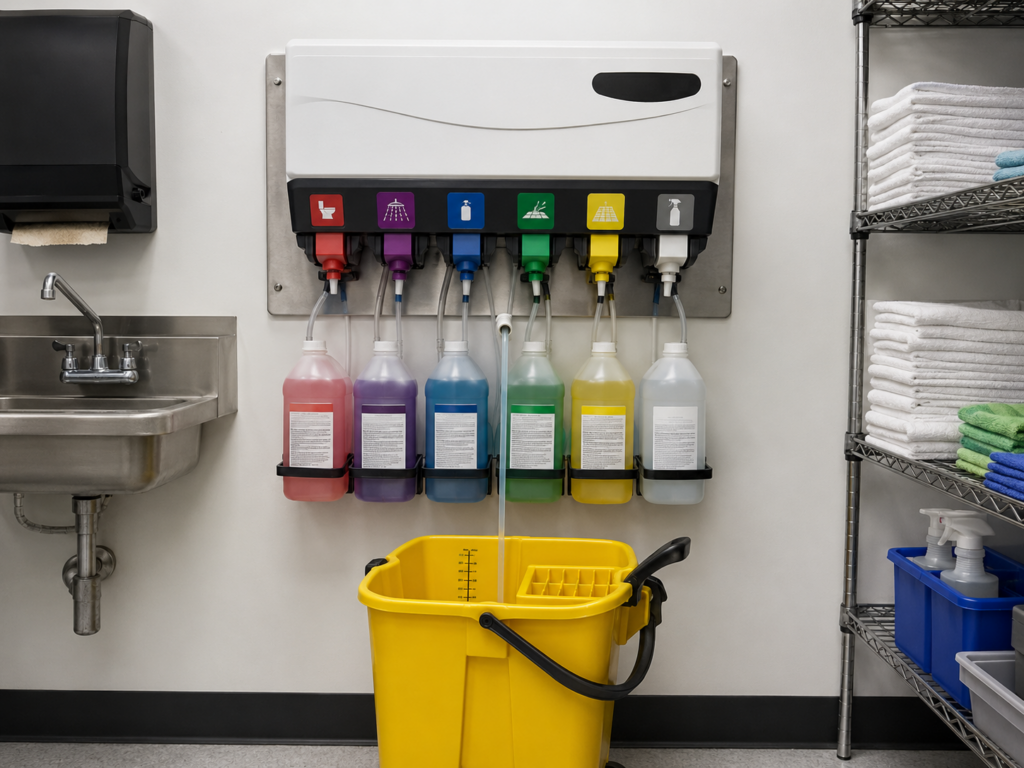
A dilution control system is a dispensing unit that automatically mixes a concentrated cleaning chemical with water at a precise, pre-set ratio. The cleaning staff connects the dispenser to a water line, places a chemical concentrate container into or near the unit, and the system delivers a correctly diluted, ready-to-use solution every time without any manual measuring.
The result is consistent chemical concentration across every mop bucket, every spray bottle, every cleaning application. No over-dilution. No under-dilution. No variation from shift to shift or employee to employee.
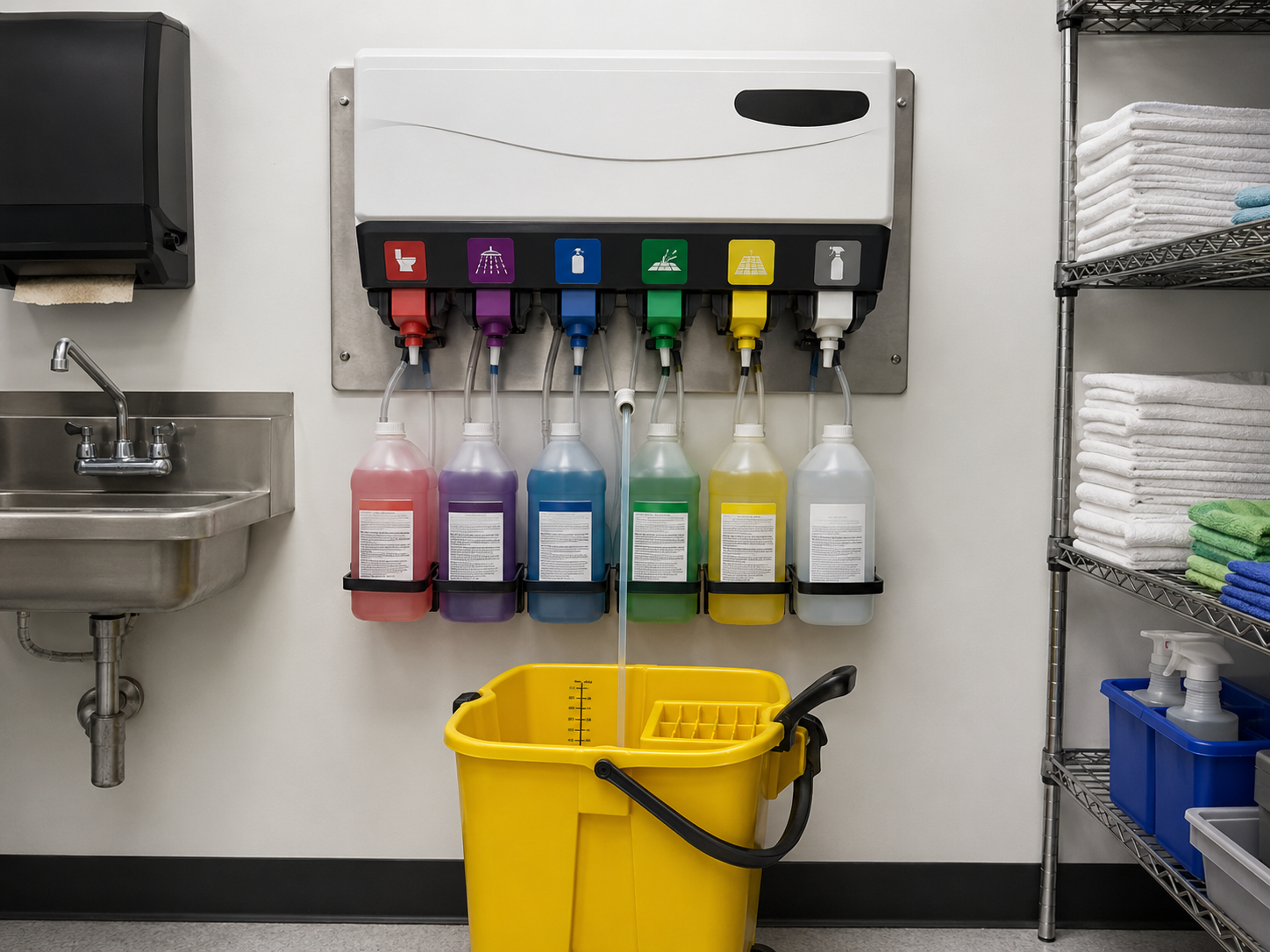
Most systems are designed around wall-mounted or portable dispensers that can fill mop buckets, spray bottles, or both in seconds. Many systems accommodate multiple chemical products through color-coded connections that prevent mix-ups between different cleaners.
The Real Cost of Manual Dilution
Before evaluating the investment in a dilution control system, it helps to understand what manual dilution is actually costing your facility.
Consider a commonly used all-purpose cleaner with a recommended dilution ratio of 1:32 (one part concentrate to 32 parts water). If your cleaning staff is pouring at a 1:10 ratio because they are guessing by eye or being cautious about cleaning effectiveness, they are using more than 3 times the concentrate per application. Over a year, across every mop bucket and spray bottle filled in your facility, that waste compounds into hundreds or thousands of dollars in unnecessary chemical costs.
The secondary costs are just as significant:
- Surface damage: Over-concentrated chemicals can damage floor finishes, strip protective coatings from surfaces, or leave chemical residue that attracts more soil, meaning floors need to be stripped and refinished more frequently
- Safety hazards: Over-concentrated cleaning chemicals increase the risk of skin and eye irritation for cleaning staff and can create respiratory hazards in enclosed spaces
- Compliance exposure: OSHA and EPA regulations govern the concentration levels of many industrial cleaning chemicals. Manual dilution errors can create compliance issues that manual processes cannot prevent
How Dilution Control Systems Reduce Costs
The cost savings from dilution control systems come from four sources that work together.
Precise Chemical Usage
The most direct saving is in chemical consumption. When every fill is measured at the correct ratio rather than approximated, facilities typically see chemical usage drop by 30 to 50 percent compared to manual mixing. For facilities spending $10,000 or more per year on cleaning chemicals, that reduction represents thousands of dollars in annual savings. Our janitorial supplies catalog includes the concentrate chemical lines designed to pair with these dispensing systems.
Reduced Product Diversity
Dilution control systems that support concentrated, multi-use products allow facilities to consolidate from a wide range of ready-to-use specialty products to a smaller number of concentrates that cover the same cleaning functions. Fewer SKUs mean simpler purchasing, less storage space, and lower inventory carrying costs.
Controlled Access and Accountability
Many dilution control systems are locked to prevent unauthorized access to concentrated chemicals and to eliminate product theft. Concentrate containers are difficult to remove without the proper key or tool, which significantly reduces the product disappearance that facilities with open chemical storage commonly experience.
Lower Packaging and Shipping Costs
Concentrated chemicals ship in smaller, lighter containers than ready-to-use products. A single gallon of concentrate, when diluted 1:32, replaces 32 gallons of ready-to-use product in packaging, weight, and storage space. For facilities receiving regular deliveries, consolidating to concentrates with dilution control reduces freight costs and reduces the storage footprint required for cleaning chemicals.
Dilution Control Systems Available Through Capital Sanitary Supply
Capital Sanitary Supply carries a full range of dilution control systems from the industry’s leading manufacturers. Each system is designed around specific product lines with different dilution ratios, chemical types, and facility environments in mind.
Diversey J-Fill and RTD Systems are among the most widely used commercial dilution platforms in institutional environments, including schools, healthcare facilities, and commercial buildings. The J-Fill system accommodates a wide range of Diversey cleaning products and delivers fast fills for high-volume operations.
Spartan Clean On The Go and Simplifill systems pair with Spartan’s concentrated chemical line to deliver accurately dosed cleaners, disinfectants, and specialty products across a range of facility types. The Clean On The Go system is particularly well-suited to facilities that need portable dilution capability rather than fixed wall-mounted units.
Ecolab Facilipro QC and Quik Fill systems are engineered for facilities that require high-precision dilution for specialized cleaning applications, including food service and healthcare environments with strict compliance requirements.
Genesan Dilution Control is Capital Sanitary’s proprietary system, available exclusively through CapSan and designed to pair with the Genesan chemical line. It is a cost-effective entry point for smaller facilities seeking the benefits of dilution control without a large upfront system investment.
3M Twist n Fill and SC Johnson TruShot 2.0 are compact, portable dispensing systems suited to office, retail, and light commercial environments where a full wall-mounted system is not required.
Choosing the Right System for Your Facility
Selecting a dilution control system depends on several factors that your Capital Sanitary Supply representative can help you evaluate.
Facility size and traffic: Larger facilities with more cleaning staff and higher cleaning frequency benefit most from full wall-mounted systems with fast fill rates and multi-product capability. Smaller facilities may find a portable or countertop system sufficient. Industrial operations with high-volume chemical usage typically see the fastest return on investment.
Chemical product lines in use: Most dilution control systems are designed to work with specific chemical families. Switching to a dilution control system is often an opportunity to review and consolidate your chemical program.
Number of cleaning stations: Facilities with multiple cleaning rooms or chemical storage areas may need multiple dispensing units, which affects the system selection and total investment.
Chemical types required: Some systems are optimized for specific product categories, such as floor care, restroom cleaning, or food service sanitizing. Multi-product systems that handle all categories from a single unit simplify training and reduce the number of units required.
Common Mistakes When Evaluating Dilution Control
Evaluating only the upfront cost. The dispenser itself typically costs between $100 and $500 per unit, depending on the system. Evaluated in isolation, this appears to be a cost. Evaluated against annual chemical savings of $1,000 to $5,000 or more at most facilities, it is a straightforward return on investment.
Not accounting for labor savings. Faster fills, fewer fill trips, and reduced time spent managing chemical inventory all represent labor savings that compound over a year.
Assuming current chemical products are optimal. Transitioning to a dilution control system is an ideal time to review whether your current chemical products are the right ones for each application, often resulting in additional savings from product consolidation. Education and government facilities in particular benefit from this kind of program consolidation.
Frequently Asked Questions: Dilution Control Systems Commercial Cleaning
What is a dilution control dispenser, and how does it work?
A dilution control dispenser is a wall-mounted or portable unit that automatically mixes a cleaning chemical concentrate with water at a precise, pre-set ratio. Staff connect the dispenser to a water line and place the concentrate container in the system. When the dispenser is activated, it delivers a correctly diluted, ready-to-use solution without any manual measuring. This eliminates the over-dilution that typically occurs when staff measures chemicals by eye — the most common cause of inflated chemical costs in dilution-control systems and commercial cleaning programs.
How much can a dilution control system save my facility?
Most facilities that switch from manual chemical measurement to dilution control systems reduce chemical consumption by 30 to 50 percent. For a facility spending $10,000 per year on cleaning chemicals, that represents $3,000 to $5,000 in annual savings. Additional savings come from reduced surface damage, lower packaging and freight costs from switching to concentrates, and lower inventory storage requirements.
Which dilution control system is best for a commercial facility?
The best system depends on your facility size, the chemical products you use, and your budget. Capital Sanitary Supply carries systems from Diversey, Spartan, Ecolab, 3M, SC Johnson, and our own Genesan line. Our specialists can evaluate your current chemical program and recommend the system that delivers the fastest return on investment for your specific operation.
Do dilution control systems work with any cleaning chemical?
Most dilution control systems are designed to work with specific chemical families from a matching manufacturer. The system and the chemical need to be compatible for accurate dilution ratios. Capital Sanitary Supply can help you identify compatible products or transition to a chemical line that pairs with the system best suited to your facility.
Are dilution control systems required by OSHA?
Dilution control systems are not mandated by OSHA, but they help facilities maintain compliance with OSHA HazCom and EPA regulations that govern the concentration levels of industrial cleaning chemicals. Manual dilution errors that result in over-concentrated solutions can create safety hazards and compliance exposure. Dilution control systems eliminate that risk by ensuring consistent, regulated concentrations on every fill.
Ready to stop overpaying for cleaning chemicals?
Capital Sanitary Supply serves facility managers across Iowa, Nebraska, and Wisconsin with dilution control systems from the industry’s leading manufacturers. Call us at (515) 244-4291 or visit capitalsanitary.com to talk with a product specialist about the right system for your facility.