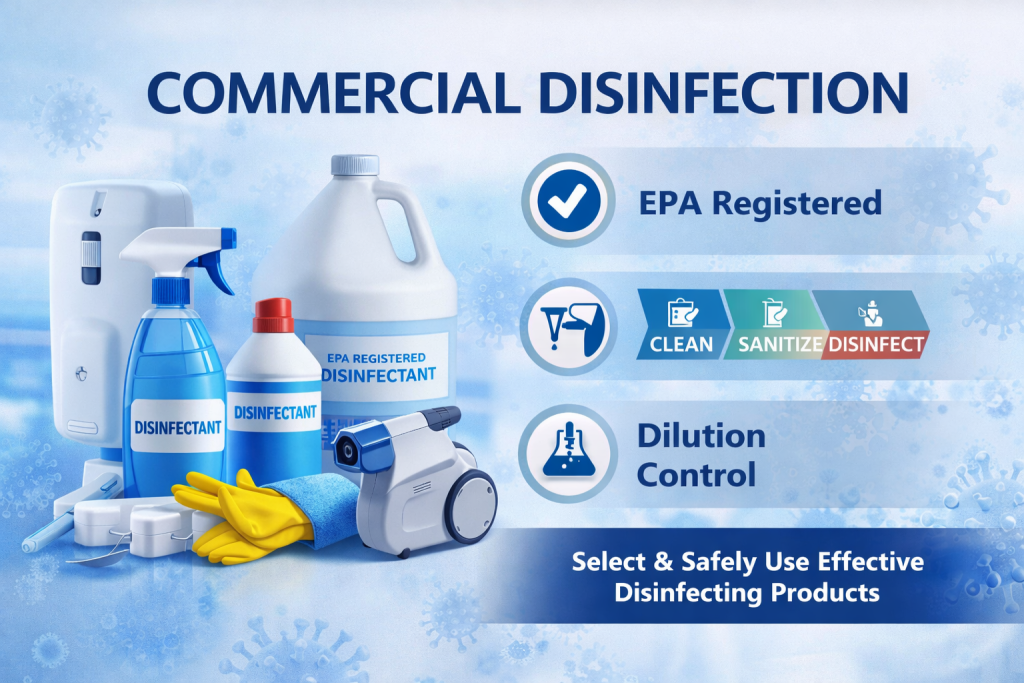
Every business owner knows that a clean facility matters. But cleaning and disinfecting are not the same thing — and the difference matters a great deal when it comes to protecting your employees, customers, and reputation.
Across Iowa, Nebraska, and Wisconsin, businesses rely on commercial disinfectants and janitorial cleaning programs to prevent the spread of illness in high-traffic environments. The right facility disinfection program stops that spread before it becomes an outbreak, a complaint, or a liability.
This guide walks through what businesses need to know about commercial disinfectants and sanitizers — how to choose the right products, where to use them, and how to build a program that is both effective and cost-efficient.
Explore our full facility cleaning solutions
Cleaning, Sanitizing, and Disinfecting: Why the Difference Matters
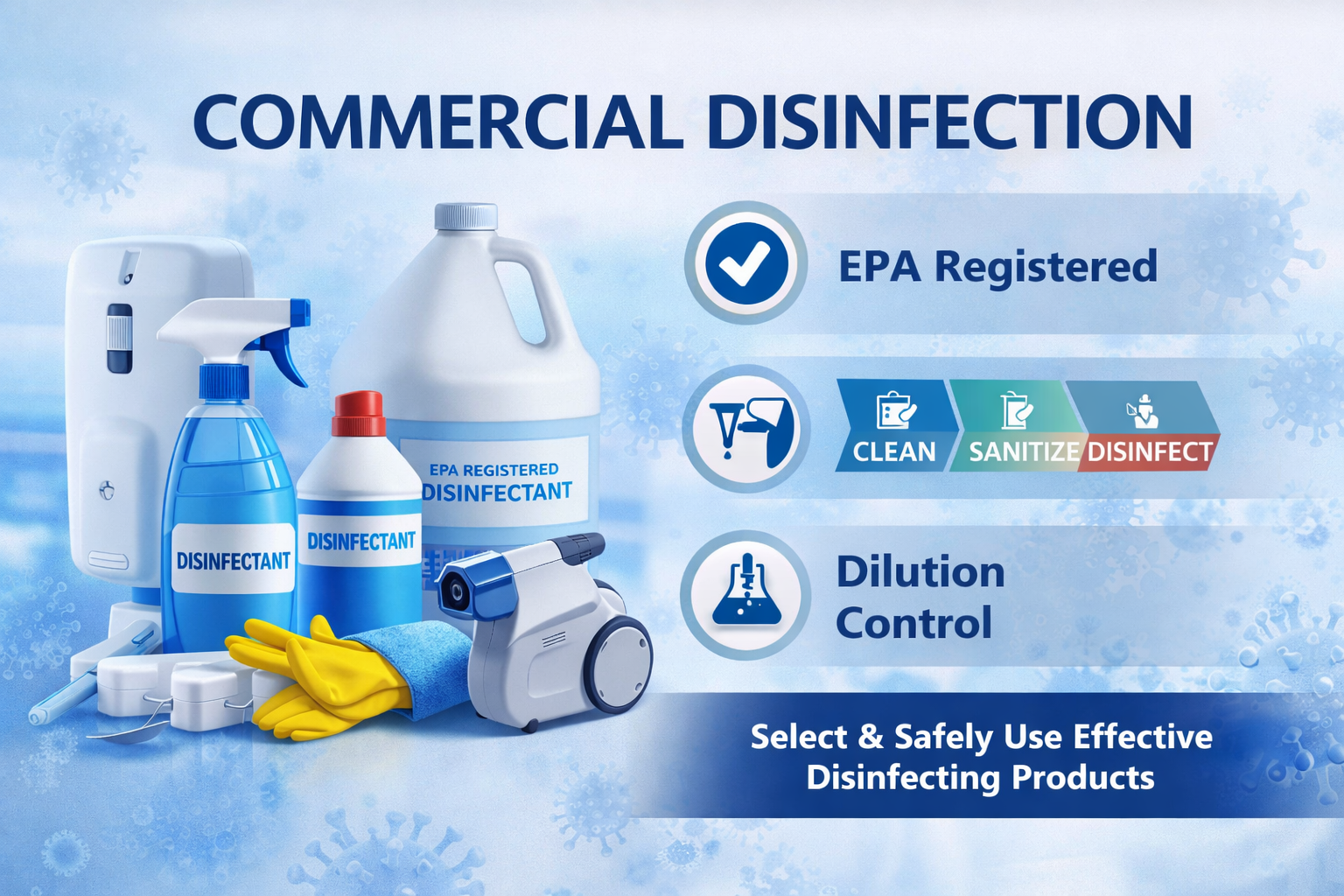
These three terms are often used interchangeably, but they describe very different levels of microbial control — and using the wrong product in the wrong situation either leaves surfaces under-protected or wastes money on overkill.
Cleaning
Cleaning physically removes dirt, debris, and organic matter from a surface using soap or detergent and water. It reduces the number of germs on a surface but does not kill them. Cleaning must happen before disinfecting — organic soil on a surface will neutralize many disinfectants before they can do their job.
Sanitizing
Sanitizing reduces the number of bacteria on a surface to a safe level as defined by public health standards. Sanitizers are commonly used in food service environments on food-contact surfaces — cutting boards, prep tables, utensils — where killing all microorganisms is not required but reducing bacterial counts to safe levels is.
Disinfecting
Disinfecting kills the vast majority of bacteria, viruses, and fungi on a surface using EPA-registered chemical agents. Disinfectants are used in higher-risk environments — restrooms, healthcare settings, locker rooms, schools — and are required by regulation in certain industries. The key distinction: a disinfectant has been tested and registered by the EPA to kill specific pathogens at specific concentrations and contact times.
Understanding the difference between cleaning, sanitizing, and disinfecting is essential for building an effective facility maintenance program. Each serves a specific purpose and using the right one in the right situation improves results while controlling costs.
Understanding the difference between cleaning, sanitizing, and disinfecting is essential for building an effective facility maintenance program. Each serves a specific purpose and using the right one in the right situation improves results while controlling costs.
| Category | Cleaner | Sanitizer | Disinfectant |
|---|---|---|---|
| Primary Function | Removes dirt, debris, and organic matter | Reduces bacteria to safe levels | Kills bacteria, viruses, and fungi |
| Kills Germs? | No | Yes (limited) | Yes (broad-spectrum) |
| Best Use Case | General surface cleaning before disinfecting | Food-contact surfaces (kitchens, prep areas) | High-touch and high-risk areas (restrooms, healthcare) |
| Common Locations | Offices, floors, general surfaces | Restaurants, food prep areas | Restrooms, schools, medical facilities |
| EPA Registration Required | No | Yes (for food-safe claims) | Yes (for kill claims) |
| Order of Use | Step 1 | Step 2 (in food areas) | Step 2 (general disinfection) |
Understanding which level of control your facility needs — and in which areas — is the foundation of an effective program. Browse commercial disinfectants and janitorial supplies
High-Risk Areas in Your Facility: Where Disinfection Matters Most
Not every surface in every facility needs to be disinfected daily. Focusing your disinfection program on the highest-risk touchpoints is both more effective and more economical than treating all surfaces the same.
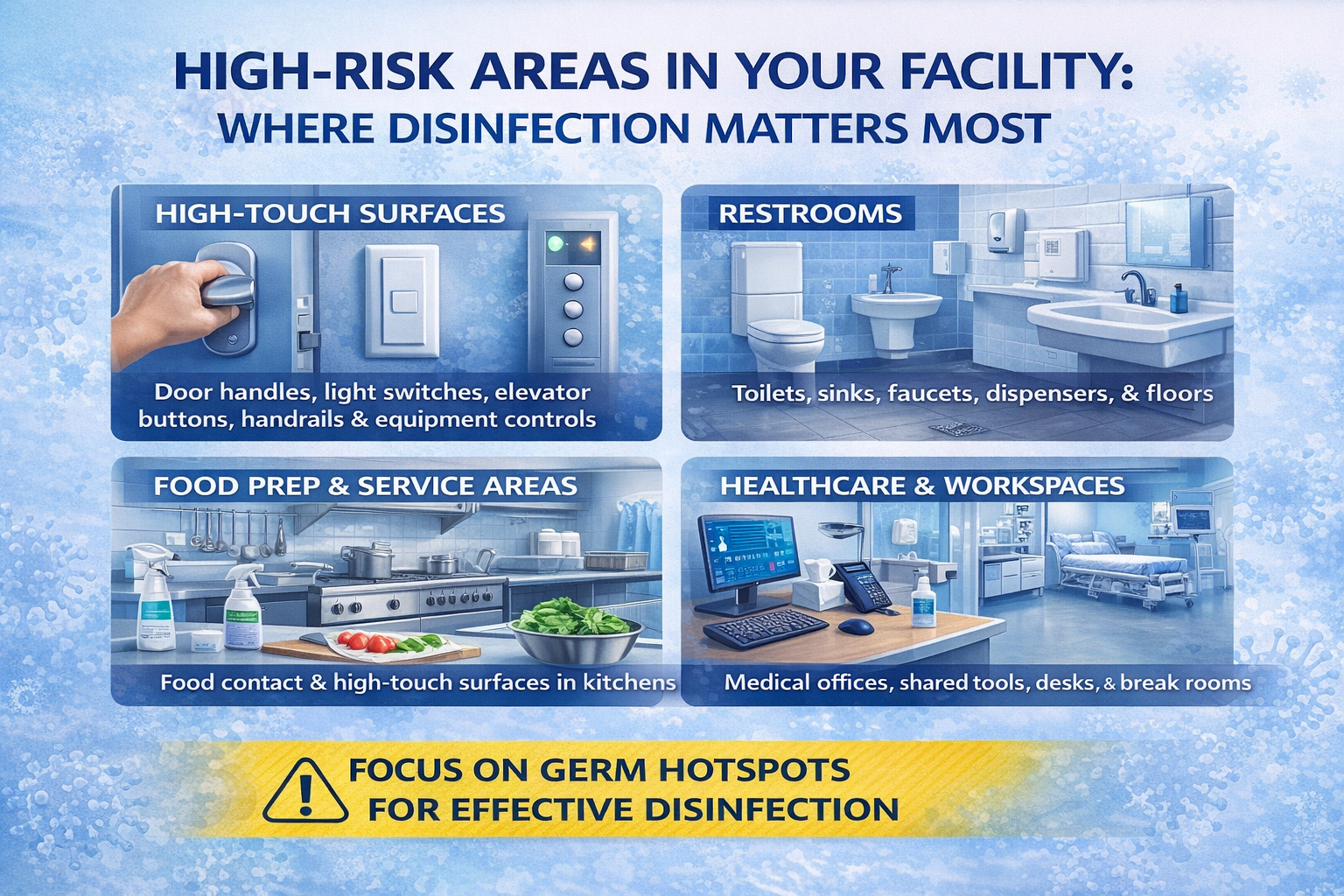
High-Touch Surfaces
Door handles, light switches, elevator buttons, handrails, faucet handles, and shared equipment controls are touched dozens or hundreds of times daily by different people. These surfaces are the primary vectors for contact transmission of illness in commercial facilities and should be disinfected at least daily — more frequently in high-traffic environments.
Restrooms
Restrooms require full disinfection of toilets, urinals, sinks, faucets, handles, dispensers, and floors. This is non-negotiable in any commercial facility. The combination of moisture, organic matter, and heavy use makes restrooms the highest-risk surface environment in most buildings.
Food Preparation and Service Areas
In commercial kitchens and food service environments, sanitizing food-contact surfaces and disinfecting non-food-contact surfaces (floors, walls, equipment exteriors) are both required to meet health code standards. Choosing the right product for the right surface — sanitizer vs. disinfectant — is critical in these environments because food-safe formulations must be used where food contact is possible.
Healthcare and Clinical Settings
Medical offices, dental practices, senior care facilities, and any space where patients are treated require hospital-grade disinfectants — products registered by the EPA that meet the higher kill claims required for healthcare environments. These products are also increasingly standard in schools and childcare facilities.
Shared Workspaces and Break Rooms
Desks, keyboards, phones, break room appliances, and shared tools are frequently overlooked but represent significant transmission risk, particularly during cold and flu season. Daily disinfecting wipe-downs of these surfaces are one of the most cost-effective disease prevention measures available to any employer.
What Makes a Disinfectant Effective? Understanding EPA Registration
Not all products marketed as “disinfectants” are created equal. The most important thing to look for when selecting a commercial disinfectant is EPA registration — a label that confirms the product has been independently tested and approved to kill specific pathogens at the labeled dilution and contact time.
When evaluating disinfectants, pay attention to these factors:
- Kill claims — the specific bacteria, viruses, and fungi the product is registered to eliminate. A product that kills bacteria may not be registered against harder-to-kill pathogens like norovirus or C. difficile spores.
- Contact time — how long the surface must remain visibly wet with the product for the kill claim to be achieved. Many products require 30 seconds to 10 minutes of contact time. If the surface dries too quickly, the disinfection is incomplete.
- Surface compatibility — some disinfectants damage certain materials, including soft metals, certain plastics, and fabrics. Always verify the product is compatible with the surfaces in your facility.
- Dilution requirements — concentrated disinfectants must be mixed at the correct ratio. Too dilute and they won’t meet kill claims. Too concentrated and you’re wasting product, potentially damaging surfaces, and exposing staff to unnecessary chemical risk.
Building Your Commercial Disinfection Program: The Essential Components
A disinfection program is more than just buying a bottle of spray and handing it to your cleaning staff. An effective program has four components working together.
The Right Products for Each Area
Select disinfectants matched to the specific risk level and surface type in each zone of your facility. A hospital-grade disinfectant for your restrooms and healthcare areas, a food-safe sanitizer for kitchen surfaces, and a general-purpose disinfectant for offices and common areas is a reasonable starting framework for most businesses.
Dilution Control Systems
One of the most overlooked elements of an effective disinfection program is how products are mixed and dispensed. Staff using too little concentrate wastes product and fails to meet kill claims. Staff using too much concentrate wastes money, risks surface damage, and exposes workers to stronger chemical concentrations than necessary.
Dilution control dispensing systems — wall-mounted or portable units that automatically meter concentrate into water at the correct ratio — solve this problem completely. They produce consistent product every time, reduce chemical waste significantly, and often reduce total chemical cost by 30% or more compared to pre-diluted ready-to-use products.
The Right Application Tools
How a disinfectant is applied matters as much as which product is used. Trigger sprayers, pump sprayers, microfiber cloths, and disinfecting wipes each have appropriate uses. For large surface areas, a spray-and-wipe method with microfiber ensures full coverage. For high-touch surfaces between cleanings, disinfecting wipes provide a fast, consistent wipe-down. Choosing the right application tool for each task ensures the product actually does its job.
Staff Training and Protocols
A disinfectant sitting on a shelf or applied incorrectly provides no protection. Staff need to know which products to use in which areas, how to dilute them correctly, what contact time is required, and what personal protective equipment to wear when handling concentrates. Written protocols and brief training sessions pay dividends in both effectiveness and liability protection.
Hand Hygiene: The Disinfection Program You Can’t Forget
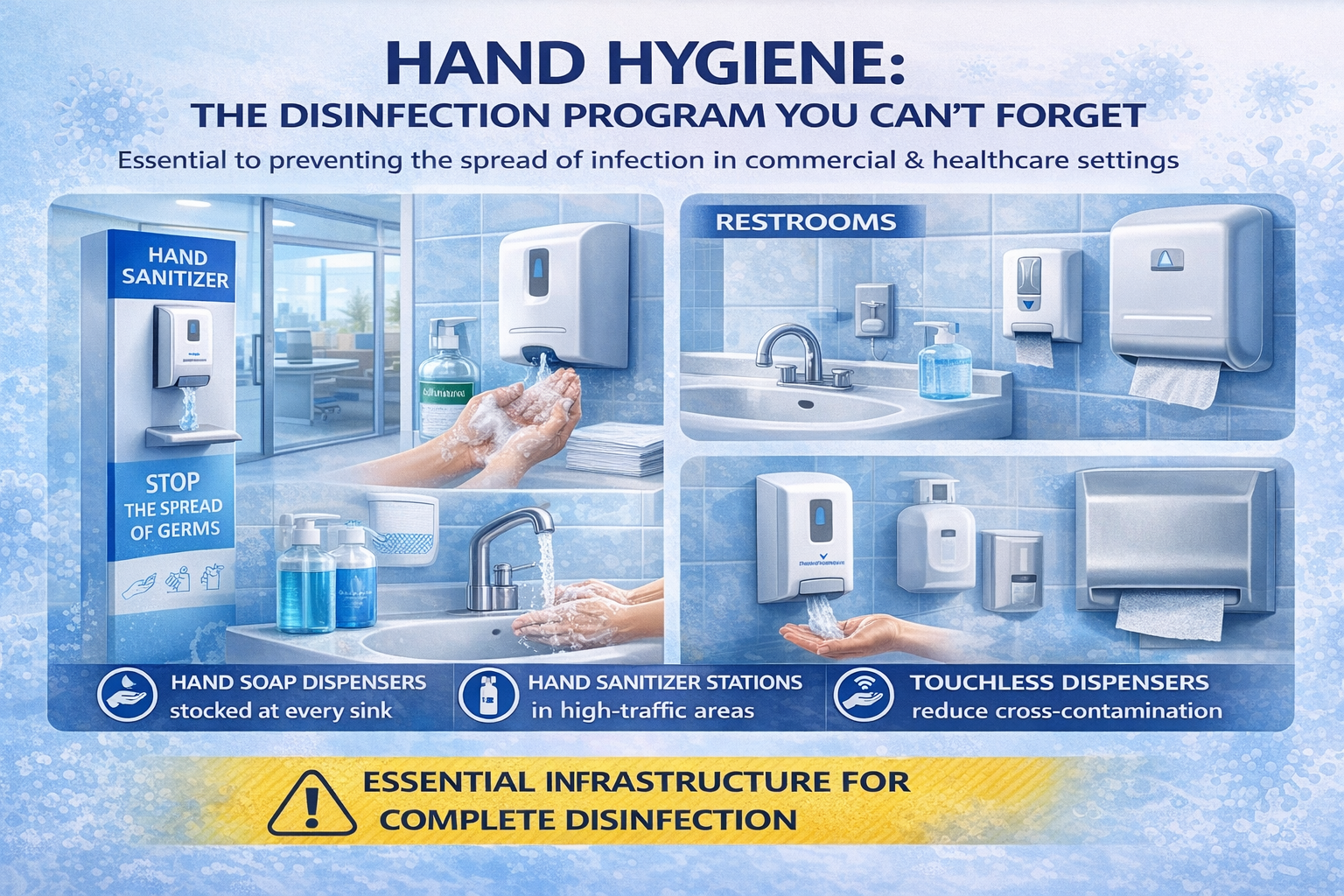
Surface disinfection addresses one vector of transmission. Hand hygiene addresses another — and it may be the more important one. The CDC consistently identifies hand hygiene as one of the most effective ways to prevent the spread of infection in commercial and healthcare settings.
A complete disinfection program includes adequate hand hygiene infrastructure throughout your facility:
- Hand soap dispensers — foam or liquid — at every sink, stocked reliably
- Hand sanitizer stations at entrances, exits, and high-traffic areas where handwashing isn’t immediately accessible
- Touchless dispensers that reduce cross-contamination from the dispenser itself
- Adequate paper towel or hand dryer availability so hand drying — an important step in hand hygiene — is convenient
Facilities that invest in both surface disinfection and robust hand hygiene infrastructure consistently see lower rates of illness-related absenteeism and customer complaints.
Choosing a Commercial Disinfectant Supplier in Iowa, Nebraska & Wisconsin
Selecting a disinfectant supplier is not just a purchasing decision — it is a partnership that affects your facility’s health, compliance, and operational costs. When evaluating suppliers, look for:
- A full product range — EPA-registered disinfectants across multiple kill-claim levels, food-safe sanitizers, hand hygiene products, and application equipment from a single source
- Dilution control expertise — the ability to design, install, and support a dispensing system that reduces waste and ensures consistent dilution
- Compliance knowledge — staff who understand regulatory requirements for your industry, whether you operate a restaurant, school, healthcare facility, or office building
- Reliable regional distribution — consistent product availability across Iowa, Nebraska, and Wisconsin so you never run out of a critical disinfectant
- Training support — resources to help your staff use products correctly and safely
Capital Sanitary Supply has served businesses across Iowa, Nebraska, and Wisconsin with professional-grade disinfectants, sanitizers, hand hygiene products, and dilution control systems for decades. Our team works with facility managers across every industry to build disinfection programs that protect people, meet compliance requirements, and control costs.
The Bottom Line: Disinfection Is Prevention
Every illness that spreads through your facility — to an employee, a customer, a student, or a patient — represents a cost. Lost productivity, absenteeism, potential liability, and reputational damage are all measurable consequences of an inadequate disinfection program. The supplies and systems that prevent those outcomes are among the most cost-effective investments a business can make.
Start by auditing the highest-risk surfaces in your facility, make sure you have EPA-registered products with the right kill claims for each area, and look at a dilution control system if you aren’t already using one. The difference between a reactive and a proactive disinfection program is a few hundred dollars a year in supplies — and it can prevent thousands in costs.
Ready to build a smarter disinfection program for your facility?
Capital Sanitary Supply carries EPA-registered commercial disinfectants, sanitizers, hand hygiene products, dilution control systems, and application equipment for businesses across Iowa, Nebraska, and Wisconsin. Our specialists can help you select the right products for your facility type and compliance requirements. Call us at (515) 244-4291 and speak with one of our product experts today!
Frequently Asked Questions: Commercial Disinfectants & Sanitizers
What is the difference between cleaning, sanitizing, and disinfecting?
Cleaning physically removes dirt and debris from a surface but does not kill germs. Sanitizing reduces the number of bacteria on a surface to a safe level — commonly used on food-contact surfaces in restaurants and kitchens. Disinfecting uses EPA-registered chemicals to kill the vast majority of bacteria, viruses, and fungi on a surface. For most commercial facilities, all three steps have a role depending on the surface and the risk level involved.
What is an EPA-registered disinfectant and why does it matter?
An EPA-registered disinfectant has been independently tested and approved by the U.S. Environmental Protection Agency to kill specific pathogens at a specific dilution and contact time. This registration is what gives a product its legal and scientific credibility as a disinfectant. Products that are not EPA-registered may claim to “clean” or “deodorize” but cannot make verified kill claims. In regulated industries like healthcare, food service, and education, EPA-registered products are often required.
How often should I disinfect surfaces in my business?
High-touch surfaces — door handles, light switches, handrails, shared equipment — should be disinfected at least once daily, and more frequently in high-traffic facilities or during illness outbreaks. Restrooms should be fully disinfected at least once daily. Food-contact surfaces in commercial kitchens should be sanitized between uses. Lower-risk surfaces like desks and shelves can be disinfected on a weekly schedule in most office environments.
Do I need hospital-grade disinfectants for my office or school?
Not necessarily for every surface, but hospital-grade disinfectants are increasingly standard in schools, childcare facilities, and any space where vulnerable populations are present. These products carry broader kill claims — including harder-to-eliminate pathogens — and provide a higher level of protection in environments where illness spreads quickly. For standard offices, a general-purpose EPA-registered disinfectant is typically sufficient for most surfaces.
What is dilution control and why does it save money?
Dilution control refers to dispensing systems that automatically mix concentrated cleaning or disinfecting chemicals with water at the correct ratio. This eliminates guesswork, ensures every application meets the labeled kill claim, prevents overuse of concentrate, and significantly reduces product waste. Most businesses that switch from ready-to-use disinfectants to a concentrated product with a dilution control system see chemical cost reductions of 30% or more without any reduction in effectiveness.
Where can I buy commercial disinfectants and sanitizers in Iowa, Nebraska, or Wisconsin?
Capital Sanitary Supply stocks a full range of EPA-registered commercial disinfectants, food-safe sanitizers, hand hygiene products, and dilution control systems for businesses across Iowa, Nebraska, and Wisconsin. With multiple regional distribution locations, we provide reliable delivery and expert product guidance for facilities of every type and size. Visit capitalsanitary.com or call (515) 244-4291 to speak with a specialist.